
The Hand of Fatima & Hamsa is one of the most powerful and recognizable symbols in Morocco. Seen on doors, jewelry, necklaces, wall art, and even city architecture, this ancient emblem carries layers of spiritual, cultural, and protective meaning that go far beyond decoration. In Moroccan society, the symbol is deeply rooted in history, religion, folklore, and daily life.
This guide explores the Hand of Fatima story, the origin of the Hamsa, its meaning in Islam, Christianity, and Judaism, and how it evolved into a symbol of protection, faith, and identity in Morocco.
What Is the Hand of Fatima & Hamsa?
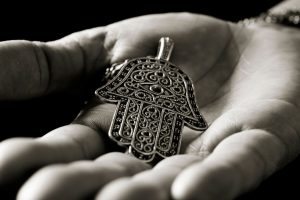
The Hamsa hand is a palm-shaped symbol, often depicted with five fingers extended symmetrically. In Morocco, it is commonly called the Hand of Fatima, named after Fatima Zahra, the daughter of the Prophet Muhammad.
The word “Hamsa” comes from Arabic and Hebrew, meaning five, symbolizing:
-
The five fingers of the hand
-
Protection against the evil eye
-
Spiritual balance and divine guardianship
In Moroccan culture, the Hand of Fatima is believed to ward off envy, jealousy, and negative energy, making it one of the most widely used protective symbols in the country.
Hand of Fatima Origin: Ancient Roots Before Religion
The Hand of Fatima origin predates Islam, Christianity, and Judaism. Archaeological evidence suggests that hand-shaped amulets were used as far back as ancient Mesopotamia and Phoenicia, where they were associated with fertility goddesses and divine protection.
In North Africa, particularly in Berber traditions, the hand symbol existed long before Islam arrived in the 7th century. The Berbers used it as a protective talisman, linking the number five to spiritual power and harmony.
Over centuries, the symbol was absorbed into Islamic culture and renamed the Hand of Fatima, gaining religious and moral meaning while retaining its protective function.
Hand of Fatima: Who Is Fatima?
To understand the Hand of Fatima story, one must understand who Fatima was.
Fatima Zahra was:
-
The daughter of the Prophet Muhammad
-
The wife of Ali ibn Abi Talib
-
A symbol of purity, patience, faith, and devotion in Islam
According to popular legend, Fatima once continued stirring a pot with her bare hand after learning of her husband’s second marriage, feeling no pain due to her emotional shock. This story transformed the hand into a symbol of patience, endurance, and silent strength.
In Morocco, Fatima represents:
-
Moral integrity
-
Protection of the household
-
Spiritual resilience
Thus, the Hand of Fatima became associated not only with protection but also with inner strength and faith.
Hamsa Hand Meaning in Islam
In Islamic tradition, the five fingers of the Hamsa are often linked to:
-
The Five Pillars of Islam
-
Faith (Shahada)
-
Prayer (Salat)
-
Charity (Zakat)
-
Fasting (Sawm)
-
Pilgrimage (Hajj)
For many Moroccans, the Hand of Fatima is not an object of worship but a symbolic reminder of faith, humility, and divine protection. It is commonly placed at the entrance of homes, above doors, or in living spaces to protect the family from harm.
Is Hamsa Haram in Islam?
One of the most frequently asked questions is: Is Hamsa haram?
Islamic scholars differ in opinion:
-
Cultural view: Many Moroccans consider the Hamsa a cultural symbol rather than a religious object.
-
Religious caution: Some scholars argue that believing the object itself has power may contradict Islamic monotheism.
-
Balanced perspective: When used as decoration or a reminder of faith—not as a supernatural protector—it is generally accepted in Moroccan society.
In practice, the Hamsa remains deeply embedded in Moroccan culture, often paired with Quranic verses or religious inscriptions to reinforce faith-based protection.
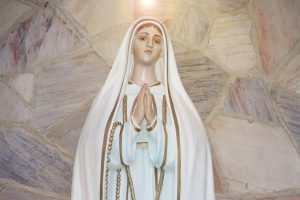
Hamsa Hand Meaning in Christianity
The Hamsa hand meaning in Christianity is less commonly discussed but equally significant. In Christian traditions, particularly among Middle Eastern Christians, the five fingers may symbolize:
-
The Five Wounds of Christ
-
Divine protection
-
God’s hand guiding humanity
Christian communities in North Africa historically adopted the symbol as a shared cultural amulet, demonstrating how the Hamsa transcended religious boundaries.
Hand of Fatima in Judaism
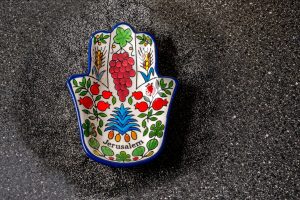
In Jewish tradition, the Hamsa is known as the Hand of Miriam, named after Moses’ sister. The five fingers represent:
-
The five books of the Torah
-
God’s protection against the evil eye
This shared symbolism across Islam, Christianity, and Judaism makes the Hand of Fatima one of the rare universal spiritual symbols in the Mediterranean world.
Hand of Fatima Door Knocker Meaning in Morocco
One of the most iconic uses of the symbol is the Hand of Fatima door knocker, especially in historic cities like Fez, Marrakech, and Essaouira.
In Moroccan architecture, the door knocker:
-
Symbolizes protection of the home
-
Wards off negative energy before it enters
-
Represents hospitality and spiritual awareness
Traditionally, many doors featured two knockers:
-
A heavier one for men
-
A lighter one for women
This allowed households to prepare appropriately, reflecting social customs and respect.
Hand of Fatima Jewelry: Necklace, Bracelets & Amulets
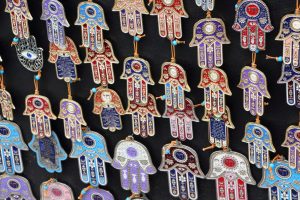
Today, the Hand of Fatima necklace and jewelry are among the most popular Moroccan accessories worldwide.
Hand of Fatima Necklace Meaning
-
Personal protection
-
Spiritual grounding
-
Connection to Moroccan heritage
Hand of Fatima Jewelry in Morocco
-
Often made of silver (associated with purity)
-
Decorated with turquoise (protection stone)
-
Engraved with eyes, Quranic verses, or geometric patterns
In Moroccan culture, jewelry is not just decorative—it is symbolic, protective, and often passed down through generations.
Discover More:
- Moroccan Rugs: The Complete Guide (History, Prices, Hidden Dangers, and Where to Buy Authentic Rugs)
- Marrakech Crafts: The Complete Guide to Morocco’s Timeless Artisanship
- Architecture in Morocco: A Living Tapestry of History, Culture, and Innovation
The Evil Eye and the Hamsa in Moroccan Belief
The fear of the evil eye (ayn) is deeply rooted in Moroccan society. It is believed that envy or excessive admiration can bring misfortune.
The Hand of Fatima is frequently combined with:
-
An eye symbol
-
Blue stones
-
Protective inscriptions
Together, they form a powerful visual language of defense, awareness, and balance.
Modern Symbolism of the Hand of Fatima in Morocco
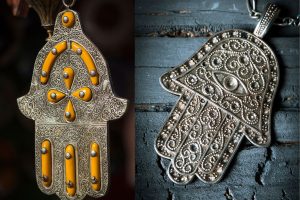
Today, the Hand of Fatima is both ancient and modern:
-
Used in fashion, tattoos, and interior design
-
Popular in Moroccan handicrafts and souvenirs
-
Recognized globally as a symbol of peace and protection
Despite modernization, Moroccans continue to respect its symbolic weight, seeing it as a bridge between ancestral wisdom and contemporary life.
Why the Hand of Fatima & Hamsa Remain Powerful Symbols
The enduring power of the Hand of Fatima & Hamsa lies in its ability to:
-
Cross religious boundaries
-
Blend spirituality with culture
-
Offer comfort, identity, and meaning
In Morocco, it is not merely a symbol—it is a living tradition embedded in homes, hearts, and heritage.
Conclusion: The Living Legacy of the Hand of Fatima in Morocco
The Hand of Fatima & Hamsa symbolism in Morocco reflects centuries of belief, resilience, and cultural continuity. From ancient origins to modern jewelry, from door knockers to spiritual meaning, this symbol tells a uniquely Moroccan story—one of protection, faith, and shared humanity.
Whether viewed through religion, history, or art, the Hand of Fatima remains one of Morocco’s most profound cultural emblems—timeless, meaningful, and deeply human.